Where simple email tools stop
At first a newsletter tool is enough: collect contacts, write once a month. At some point you notice everyone gets the same email although they want different things. Prospects who nearly bought hear nothing more. And sales does not know who just looked at the pricing page three times.
Typical signs you need automation:
- You send the same follow-up emails by hand.
- Leads go cold because nobody notices they are hot.
- Customers get ads for things they already have.
- Marketing and sales work from separate lists.
Who ActiveCampaign is relevant for
Not every business needs an automated marketing system right away. ActiveCampaign pays off when several of these apply:
- You regularly get new contacts, from website, ads or events.
- Days or weeks pass between first contact and purchase.
- You have more than one offer or more than one audience.
- Someone in the team has time to build and maintain automations.
Important: a tool does not replace a strategy. If you do not know what a contact should experience after signing up, ActiveCampaign just builds more complicated chaos.
How automations work in ActiveCampaign
Every automation follows the pattern event, action, goal. An event starts the flow, actions happen one after another, a goal ends it as soon as it is reached.
| Building block | Examples |
|---|---|
| Triggers | Form submitted, email opened or link clicked, page visited, tag added, inactive for a while |
| Actions | Send email, wait, add tag, update field, create deal, task for sales, webhook |
| Conditions | If clicked, path A, otherwise path B |
| Goals | Appointment booked, purchase, deal won: whoever reaches the goal leaves the flow |
Use cases
- Lead nurturing: prospects receive helpful content over weeks until they are ready for a conversation.
- Onboarding: new customers learn step by step how to use your product.
- Segmentation: tags and fields from forms, clicks and purchases split contacts into groups that get matching emails.
- Sales: a CRM with pipeline shows deals by stage. Lead scoring awards points for opens, clicks and visits and flags hot contacts.
What ActiveCampaign costs in 2026
ActiveCampaign charges by plan and number of contacts. Prices in US dollars for 1,000 contacts, as of November 2026 according to public pricing information:
| Plan | Annual, per month | Monthly |
|---|---|---|
| Starter | $15 | $19 |
| Plus | $49 | $59 |
| Pro | $79 | $99 |
| Enterprise | $145 | $179 |
With more contacts the price rises considerably. CRM features such as pipelines and lead scoring are included or cost extra depending on the plan. Check the current pricing page.
Effort and risks
- Complexity grows fast. Twenty automations setting tags for each other are a mystery after a year. Document what each automation does.
- Too many emails. When several flows run at once, a contact quickly gets three emails a day.
- Data protection. ActiveCampaign is a US provider. Review the data processing agreement and data transfers.
- Cost. It gets more expensive as your list grows. Clean out inactive contacts.
Clean data from forms
The best automation fails on poor input data. If a form only knows name and email, ActiveCampaign does not know what the contact wants. A multi-step form asks about topic, budget or timing first, and exactly these answers become fields and tags for segments and lead scoring.
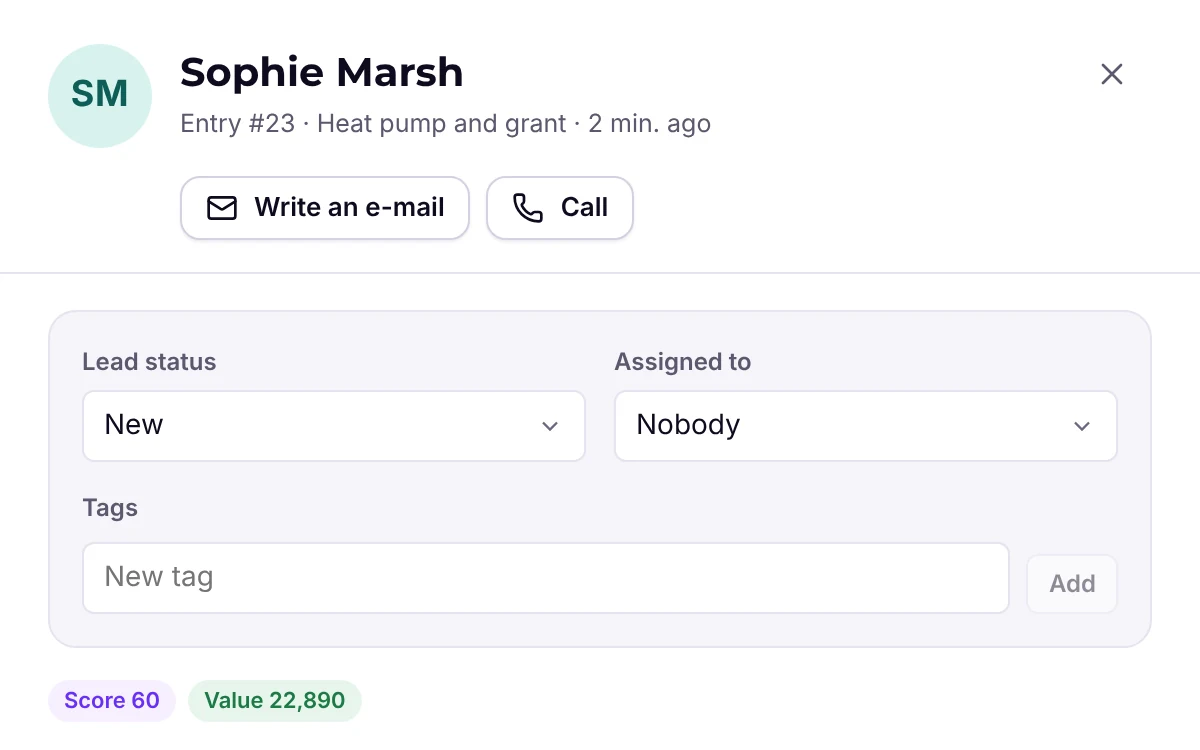
Funnelforms Pro creates contacts directly in ActiveCampaign. You set up the connection once and it is available in all forms. In addition, every entry in your WordPress gets status, tags, assignee and notes, and Funnelforms can calculate its own lead score from the answers.
ActiveCampaign together with funnels
A funnel on the website and an automation in the email tool are two halves of one flow. The funnel asks the questions and sorts, the automation continues the conversation. The more precise the first half, the less the second has to guess.
An example: a prospect selects “consulting for companies” and “start within three months” in the form. These become two tags. ActiveCampaign starts the matching sequence and, on the second tag, creates a deal for sales right away. Keep the number of fields small. Too many or unclear fields lower the completion rate of the form.
Start small
- One welcome sequence with three emails for new contacts.
- One tag per interest, set from the answer in the form.
- One notification to sales when someone requests a quote.
- Measure after four weeks: opens, clicks, appointments. Only then build the next automation.
Frequently asked questions
What does ActiveCampaign cost?
For 1,000 contacts, Starter costs $15 a month billed annually, Plus $49, Pro $79 and Enterprise $145. Monthly billing costs more, as do more contacts (as of November 2026, check with the provider).
Is ActiveCampaign a CRM?
Partly. It has contacts, deals, pipelines and lead scoring. Larger sales teams often add a dedicated CRM such as HubSpot or Pipedrive.
Can Funnelforms pass contacts to ActiveCampaign?
Yes, Funnelforms Pro has a direct ActiveCampaign integration, plus webhooks, Zapier, Make and n8n.