What GetResponse is
GetResponse is a marketing platform headquartered in Poland. At its core is email marketing: newsletters, automated sequences, segments. On top come landing pages, forms, pop-ups, webinars, a website builder and features for online shops.
The idea of a suite: instead of five tools with their own data, you work in one system where contacts, campaigns and reports sit together.
A suite is also a decision about how you work
A suite sets the processes. That is good when your team should work consistently: same templates, same reports, one place for everything. It gets in the way when you have many special cases that do not fit the standard flows.
| Standardisation fits | Specialist tools fit better | |
|---|---|---|
| Team | Small, little specialist knowledge, one person for marketing | Specialists for email, web and sales |
| Processes | Repeatable: lead magnet, welcome sequence, newsletter | Many special paths, own data sources |
| Goal | Fewer tools, less upkeep | Best tool for each job |
Key features
- Email marketing with editor, templates, segments and send by time zone.
- Automations as flows with triggers, conditions and actions, more extensive in higher plans.
- Landing pages and forms to collect contacts.
- Webinars inside the platform, depending on plan.
- Contact management with tags, scoring and fields.
What GetResponse costs in 2026
GetResponse charges by plan and contacts. Starting prices in US dollars for 1,000 contacts, billed monthly, as of November 2026 according to public pricing information:
| Plan | From per month | Users |
|---|---|---|
| Starter | $19 | 3 |
| Marketer | $59 | 5 |
| Creator | $69 | 5 |
| Enterprise | on request | by agreement |
Annual billing is about 18 percent cheaper according to the provider. Prices rise considerably as your list grows. Euro prices sometimes differ. Check the current pricing page.
Typical scenario: switching
Many come to GetResponse because their setup has grown: a newsletter tool, a page builder, a webinar tool, each with its own contacts. Switching pays off if you really drop tools, not just add one.
- Inventory: which tools, contacts and flows exist today?
- What moves, what stays, what goes?
- Only migrate contacts with valid consent.
- Rebuild flows rather than copy them one to one, it is often simpler.
- Cancel old tools only once the new flows have run stably for a month.
Decision grid: five questions
- How many tools does GetResponse actually replace for you?
- Who maintains the platform, and how much time do they have?
- Which special cases do you have, and can they be mapped?
- What does the price look like at twice the contacts?
- How do contacts get in from website, forms and shop?
Process before features: first describe the path from first contact to customer on one page. Then check whether the suite maps exactly that path.
Limits of GetResponse
- Breadth over depth. Landing pages, webinars and shop features are solid, but specialist tools go further in each area.
- Cost grows with the list. Prices rise considerably with more contacts, including ones who never open.
- Users per plan are limited. According to pricing information, Starter allows three users, Marketer and Creator five.
- Simple forms. For enquiries with many questions or calculators you need a separate form tool.
The first 30 days
- Week 1: authenticate the domain, import contacts with consent, set up sender and footer.
- Week 2: build a welcome sequence with three emails and check it with test contacts.
- Week 3: connect website forms and set tags per source.
- Week 4: send the first newsletter, review opens and clicks, switch off old tools you no longer need.
Contacts from forms into GetResponse
A suite's forms are usually simple: name, email, maybe one more field. For enquiries where you want to know what it is about first, that rarely suffices. With a multi-step form in your WordPress you ask about topic, scope and timing, then pass the contact on.
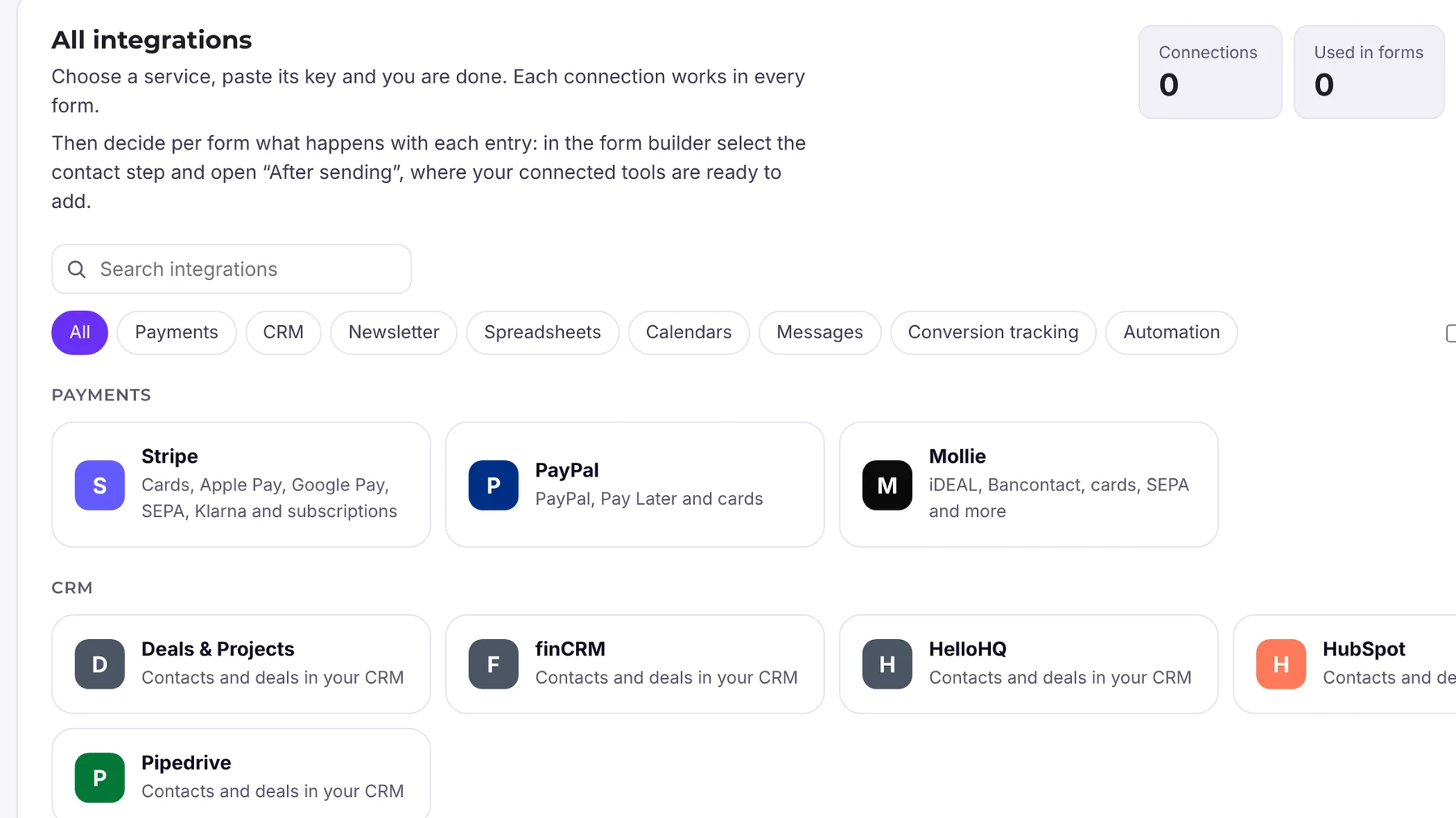
Funnelforms Pro creates contacts directly in GetResponse. You set up the connection once and it is available in all forms. For your own flows, use webhooks, Zapier, Make and n8n.
Frequently asked questions
What does GetResponse cost?
For 1,000 contacts, Starter starts at $19 a month, Marketer at $59 and Creator at $69. Annual billing is cheaper, more contacts cost more (as of November 2026, check with the provider).
Is a suite like GetResponse worth it?
If it really replaces several tools and your process fits the standard paths, yes. With many special cases, specialist tools are often better.
Can Funnelforms pass contacts to GetResponse?
Yes, Funnelforms Pro has a direct GetResponse integration, plus webhooks, Zapier, Make and n8n.